
AI Ticketing Systems: Revolutionizing Customer Support Through Intelligent Automation
Discover how AI ticketing systems transform support operations with automated classification, intelligent routing, and predictive analytics for faster, more personalized service delivery.

AI Ticketing Systems: Revolutionizing Support
AI is redefining how organizations manage customer support tickets—shifting from static queues to intelligent, self-optimizing systems. As issue volumes grow and customer expectations continue to rise, AI in ticket systems is helping support teams automate routine tasks, surface urgent issues, and deliver faster, more personalized responses. From natural language processing (NLP) to predictive routing, the application of help desk AI automation is reshaping how teams engage with customers and scale operations efficiently. In this article, we explore how AI is transforming ticket systems—from automating prioritization and categorization to enhancing overall customer service.
What Are AI Ticketing Systems?
An AI ticketing systems are intelligent support management platforms that automate and optimize the handling of service requests through artificial intelligence. Unlike traditional ticket systems that rely on manual triage and static rules, AI-driven platforms use technologies like machine learning ( ML) and natural language processing (NLP) to interpret ticket content, classify issues, prioritize urgency, and route requests to the appropriate agent or resolution path.
These systems perform real-time ticket classification, sentiment detection, intent recognition, and predictive assignment—effectively reducing human intervention in repetitive tasks. As a result, AI in ticket systems improves response times, reduces operational load, and enables scalable service delivery.
By embedding AI automation in help desks, organizations can not only streamline issue tracking workflows but also generate contextual response suggestions, auto-resolve common queries, and surface actionable insights from ticket trends. This evolution in help desk AI represents a shift from passive logging tools to proactive service engines capable of learning and adapting over time.
Whether applied in customer support, IT service desks, or internal ops, AI ticketing systems redefine how teams manage requests—making ticket systems automation a strategic lever for both efficiency and service quality.
Why Do Automated AI Ticketing Systems Matter?
Modern support teams are under pressure to deliver rapid, round-the-clock responses without scaling headcount. Automated AI ticketing systems meet this challenge by eliminating manual triage, accelerating ticket resolution, and enabling service operations to scale efficiently.
Speed and Efficiency
According to a survey by HubSpot, 66% of customers expect a response within 05 minutes of reaching out. Traditional systems, reliant on human agents for categorization and routing, struggle to meet this benchmark—especially during surges in ticket volume. AI-powered help desk automation enables instant triage and categorization, ensuring tickets are immediately routed to the appropriate queue or resolved automatically where possible.
AI in ticket systems allows teams to handle significantly more inquiries with fewer resources. McKinsey reports that AI-based automation can reduce customer service operational costs by up to 40%. This is achieved through faster resolution times, elimination of manual backlogs, and intelligent escalation of only high-complexity cases to human agents.

Customer Satisfaction and Retention
Speed isn’t just a metric—it directly impacts satisfaction. 75% of consumers rank fast response time as the #1 factor in a good customer experience. Companies adopting ticket system AI report up to a 20% improvement in customer satisfaction scores, driven by reduced wait times, more accurate responses, and personalized engagement.
Moreover, help desk AI tools operate 24/7, maintaining consistent SLA performance across time zones—especially critical for global businesses.
Scalability and Resource Optimization
AI automation in help desks allows issue tracking systems to dynamically scale as demand increases. Unlike manual systems that require proportional increases in staffing, automated platforms handle large volumes of tickets with stable operational costs. AI doesn’t just manage more tickets—it learns from them, continuously improving routing accuracy and response quality through machine learning.
Focused Human Intervention
AI-powered ticketing doesn’t eliminate human agents—it enhances them. Low-priority, repetitive tickets are auto-resolved, allowing skilled staff to focus on complex, high-impact issues. This division of labor increases both agent efficiency and job satisfaction.
Quick Stats
| Metric | Impact with AI Ticketing |
|---|---|
| Customer expectation for response | 66% expect replies within 05 mins |
| Fast response importance | 75% rank it as top CX factor |
| Cost reduction via AI automation | Up to 40% |
| Customer satisfaction improvement | Up to 20% |
| Support availability | 24/7 with no downtime |
By automating key workflows—from ticket logging and classification to real-time response suggestion—AI ticket systems are no longer optional. They are foundational tools for businesses seeking to scale without compromising service quality.
Challenges of Traditional Ticketing Systems
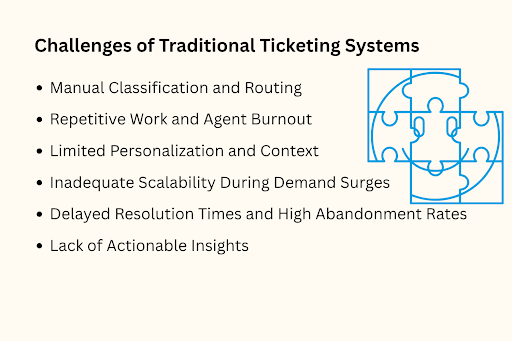
Traditional ticketing systems were designed to centralize service requests, but in high-demand environments, their manual processes have become a significant liability. These legacy systems often rely on static workflows, human triage, and manual follow-ups—resulting in delays, inefficiencies, and poor customer experiences. As customer expectations evolve, so do the shortcomings of conventional ticket workflows.
Manual Classification and Routing
One of the most fundamental flaws in traditional systems is the manual nature of ticket classification and assignment. Support agents must read, interpret, and tag each ticket before routing it to the appropriate team. This slows down the entire support pipeline and leads to misrouting errors, especially during high-volume periods.
According to internal performance audits across service desks, up to 30% of tickets are misrouted in traditional workflows, requiring additional time to reassign and correct. These inefficiencies lead to higher first response times and customer frustration.
“Without AI-based classification, every ticket becomes a bottleneck.”
Repetitive Work and Agent Burnout
In traditional systems, agents are burdened with repetitive, low-value tasks—such as responding to the same FAQs or manually tagging tickets. Over time, this redundancy reduces productivity and job satisfaction.
A Zendesk study revealed that 70% of support agents feel overwhelmed by ticket volume, with repetitive tickets being a top contributor. The lack of automated triage or AI-generated suggestions makes every interaction labor-intensive and inconsistent.
Limited Personalization and Context
Legacy issue tracking systems treat each ticket in isolation. They don’t contextualize incoming requests based on past interactions, sentiment, or customer preferences. This forces agents to manually dig through historical data—if it’s even available.
“Traditional systems lack memory. AI-driven help desks remember context—humans don’t scale that well.”
The result? Inconsistent tone, generic responses, and customer dissatisfaction. Without help desk AI integration, there’s no dynamic adaptation to the user’s behavior or history.
Inadequate Scalability During Demand Surges
Manual ticket systems can’t scale on-demand. Whether it’s Black Friday for e-commerce or a major software outage in ITSM, traditional systems quickly collapse under the pressure of increased traffic.
Support teams must hire additional agents to keep up, increasing operational costs. However, McKinsey reports that***human labor accounts for up to 70% of customer service costs ***. This makes manual scaling both expensive and inefficient.
AI automation in help desks allows companies to scale elastically without proportional headcount increases—something traditional models cannot achieve.
Delayed Resolution Times and High Abandonment Rates
Manual handling delays ticket resolution. According to Daktela, 38% of customers will abandon a service interaction if they have to wait too long for a response. These delays damage brand trust and inflate churn rates, especially in SaaS and subscription-driven businesses.
AI in ticket systems enables real-time responses, reducing resolution time and keeping users engaged.
Lack of Actionable Insights
Traditional help desk tools generate mountains of data but provide limited visibility into performance trends, root causes, or customer pain points. There’s no AI-driven analytics engine to surface anomalies, predict future ticket trends, or optimize workflows in real time.
This creates a reactive support culture—where companies only respond after things break, instead of proactively addressing systemic issues.
Traditional Ticketing vs. AI-Powered Ticketing
Below is a detailed comparison showing how AI transforms traditional ticket system limitations into opportunities for operational efficiency.
| Feature | Traditional Ticketing | AI Ticketing |
|---|---|---|
| Response Time | Manual triage causes delays, especially under high volume. | Automates sorting and classification, enabling near-instant responses. |
| Ticket Routing | Relies on rigid rules and agent input, leading to misrouting. | Uses NLP and LLMs to intelligently classify and route tickets to the right team. |
| Prioritization | All tickets are treated equally unless manually flagged. | Automatically prioritizes based on urgency, sentiment, and business context. |
| Self-Service Options | Minimal or passive self-service — customers must wait. | Offers chatbots and dynamic FAQs that resolve repetitive issues 24/7. |
| Support Team Workload | High due to repetitive ticket handling and classification tasks. | Offloads repetitive tickets so agents can focus on strategic, complex issues. |
| Context Awareness | Agents must search manually for history and previous touchpoints. | AI recalls full interaction history and customer sentiment in real time. |
| Scalability | Scaling requires hiring and onboarding new support agents. | Scales instantly without increasing headcount, handling thousands of tickets in parallel. |
| Operational Costs | High due to labor-intensive processes. | Reduced costs through automation — up to 40% lower support expenses. |
| Customer Experience (CX) | Inconsistent and slower, especially during peak demand. | Faster, more personalized, and available 24/7 — leading to up to 20% higher CSAT. |
Legacy ticketing systems were built for stability, not agility. In today’s real-time, high-expectation environment, these systems fall short in speed, scalability, and intelligence. Ticket systems automation through AI resolves these limitations—streamlining workflows, reducing costs, and elevating customer experiences.
“AI isn’t just enhancing support—it’s redefining how issues are tracked, resolved, and prevented.”
Benefits of AI-Powered Automated Ticketing System
Traditional ticketing systems relied heavily on manual triage: human agents had to read, categorize, and route every incoming ticket—a process riddled with delays, inconsistencies, and misrouted requests. AI in ticket systems has fundamentally transformed this workflow by automating these stages, accelerating resolution times, improving service quality, and minimizing resource waste.
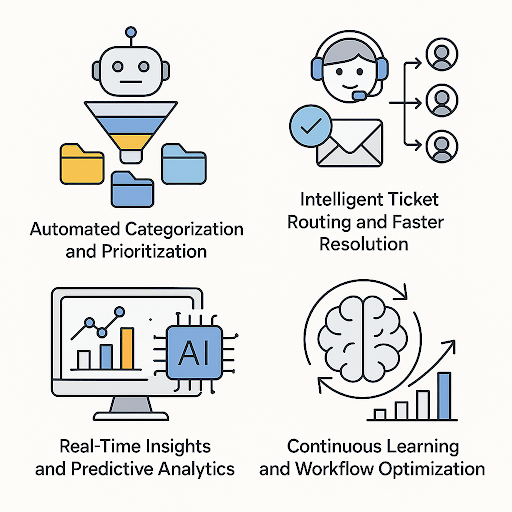
Automated Categorization and Prioritization
AI-powered ticket systems use Natural Language Processing (NLP) to analyze unstructured ticket content in real time. This enables the system to:
- Categorize requests into predefined buckets such as hardware, software, access issues, or network faults.
- Prioritize based on urgency, customer sentiment, and keywords. For instance, a ticket stating “my server is down” with negative sentiment would be fast-tracked for escalation.
📊 According to Freshworks, organizations using AI-powered ticket categorization reduce triage time by up to 75%, significantly cutting first response delays.
Sentiment analysis and contextual understanding—core NLP functions—allow the system to not only detect technical issues but also identify emotional cues like frustration, ensuring urgent issues are addressed first. This reduces customer churn and boosts satisfaction metrics.
Intelligent Ticket Routing and Faster Resolution
One of the most impactful applications of AI in ticket systems is intelligent routing, including predictive routing that matches tickets to the best available agent based on historical resolution success and skill fit. By analyzing ticket metadata, historical handling patterns, and agent specialization, AI ensures each ticket is sent to the most qualified support agent.
- For example, hardware-related issues are automatically routed to IT support, while access control issues are sent to security operations.
- AI also suggests resolutions to agents based on similar closed tickets, enabling faster problem-solving.
🧠 Unthread reports that support teams using GPT-based ticket assistants reduced average ticket handling time significantly while improving first contact resolution (FCR) rates.
Moreover, repetitive requests (e.g., password resets, account unlocks) can be resolved instantly through automated workflows or self-service portals, reducing agent load and enabling customers to resolve basic issues without delays.
Real-Time Insights and Predictive Analytics
Beyond triage and resolution, AI provides deep operational intelligence that traditional systems cannot match. By analyzing historical and ongoing ticket data, AI-powered help desk automation tools generate:
- Trend forecasts: Identify recurring issues before they spike.
- Performance dashboards: Track agent response times, SLA breaches, and CSAT scores in real time.
- Bottleneck diagnostics: Detect where in the workflow tickets get delayed most frequently.
Predictive analytics also helps teams proactively allocate resources. If AI detects a surge in “login issues” every Monday morning, it can suggest increasing L1 staffing or improving user education via automated tips.
Continuous Learning and Workflow Optimization
The power of machine learning in issue tracking system AI lies in its feedback loop. Every resolved ticket adds to the AI’s knowledge base:
- AI learns which resolutions worked best for which issues.
- It refines its routing logic and categorization accuracy over time.
- It detects changing customer behavior or terminology, ensuring the system evolves with users.
🔄 AI systems continuously learn from historical ticket data, allowing support workflows to become smarter and more efficient over time. As models retrain, they adapt to changing customer behavior, improving ticket routing, response suggestions, and resolution speed.
Additionally, organizations gain the ability to continuously optimize support workflows without increasing headcount. AI models surface inefficiencies—like unnecessary escalations or duplicate tickets—allowing managers to fine-tune support processes and improve service desk KPIs over time.
Examples of AI Ticketing System Use Cases
AI ticketing systems are transforming how organizations across sectors handle customer support, workflow automation, and service delivery. From e-commerce to healthcare and HR, these systems reduce manual overhead, accelerate response times, and scale support operations effectively. Here are five industries where AI ticketing systems are driving real-world impact.

Retail and E-commerce
Retail and e-commerce businesses use AI ticketing systems to enhance the customer experience, especially during high-volume shopping periods. AI acts as a virtual assistant that helps customers with order tracking, returns, FAQs, and product recommendations—often without involving a human agent.
For example, Grove Collaborative uses Zendesk AI for ticket triage automation. The system captures request types, assigns the right agent automatically, and eliminates manual routing, which boosts productivity. During peak periods like holiday sales, AI ticketing ensures that routine inquiries are instantly resolved while human agents focus on high-touch customer interactions.
Healthcare
In the healthcare sector, help desk AI automation plays a critical role in managing high volumes of patient interactions. AI chatbots assist with scheduling appointments, confirming bookings, and sending automated reminders, which minimizes missed visits and reduces staff workload. Patients benefit from being able to book or reschedule doctor visits 24/7 through conversational interfaces.
Medline, a leading distributor of medical supplies, uses Zendesk to handle more than 800,000 tickets each year. It has implemented AI bots to boost employee productivity and plans to deploy Zendesk Copilot to assist agents in real-time decision-making.
Travel and Hospitality
AI ticketing systems are especially valuable in the travel and hospitality industry, where customers frequently need real-time assistance for bookings, cancellations, and itinerary changes. AI-powered travel chatbots function like digital concierges, handling booking modifications, offering personalized upsells, and providing multilingual support around the clock.
Baleària, a maritime transportation company, implemented a Zendesk-powered travel chatbot to deflect frequently asked questions. The result was a significant reduction in ticket volume and a 96 percent customer satisfaction (CSAT) score, showcasing how AI can improve efficiency while maintaining high service standards during operational disruptions or peak travel seasons.
Recruitment and Human Resources
HR and recruiting teams leverage AI ticketing to streamline the candidate experience and internal workflows. AI bots can automate updates about job applications, coordinate interviews, and deliver onboarding checklists, which ensures that candidates remain engaged without overloading HR personnel. These systems also function as workforce management tools that help teams respond to seasonal fluctuations in staffing needs.
Peek, a software company, uses Zendesk Workforce Management (WFM) to ensure that support resources are properly allocated. Processes that once took four to five hours—such as scheduling and resource planning—can now be completed in just five minutes with the help of AI ticketing tools, significantly improving HR efficiency.
IT and Technical Support
In IT departments, automated issue tracking powered by AI helps resolve technical problems faster and prevents ticket duplication. AI models analyze historical ticket patterns, detect early indicators of service failures, and suggest preventive actions, such as patching or system updates.
When a spike in incident reports occurs, the system flags the root cause and routes it to the appropriate IT team, reducing downtime. Predictive analytics capabilities in these platforms have led to measurable benefits: according to the ServiceDesk Institute, organizations using predictive AI in IT support have seen a _30 percent drop in ticket volume _. These systems not only reduce Mean Time to Resolution (MTTR) but also enable IT teams to proactively manage system health and allocate resources more effectively.
The Future of AI Ticketing Systems
AI ticketing systems are rapidly transitioning from basic automation tools to intelligent support engines capable of predicting, personalizing, and preempting customer needs. By 2030, AI-driven ticket systems are projected toautomate up to 80% of customer support tasks, significantly reducing human workload while improving response speed and service consistency. A key future trend is the shift toward predictive AI in ticket systems, where machine learning models will proactively identify patterns and prevent issues before they escalate, with predictive routing ensuring optimal case-to-agent assignment in real time. As 69% of experience leaders highlight forecasting labor needs as a top challenge, AI’s role in optimizing agent allocation will become mission-critical. In parallel, the integration of emotional intelligence and sentiment analysis will allow help desk AI to recognize frustration or urgency in real time—enabling dynamic prioritization and escalations. Additionally, voice AI and conversational interfaces are expected to mature, allowing users to submit and track tickets via natural speech—bridging accessibility and convenience. In this trajectory, AI automation in help desks will no longer be a luxury—it will be the backbone of scalable, resilient, and adaptive customer support ecosystems. Organizations that invest in how to automate ticket systems today are securing a foundation for long-term competitiveness and service excellence. Ready to streamline your support? Discover how AI ticketing systems can transform your workflows and customer experience. 👉 Try our AI ticketing solution at open-ticket-ai.com
FAQs
Q: How fast can AI ticketing systems respond?
A: Many AI-powered help desks can respond in under 5 minutes on average, thanks to automated triage, prioritization, and intelligent routing.
Q: Can AI ticketing systems reduce operational costs?
A: Yes. Studies show AI ticket automation can reduce customer service costs by up to 40% by minimizing manual work and improving resolution speed.
Q: What is predictive routing in AI ticketing?
A: Predictive routing uses AI to match each ticket with the most suitable agent based on skills, past performance, and historical resolution patterns, improving first-contact resolution rates.
Q: Do AI ticketing systems replace human agents?
A: No. They handle repetitive and low-complexity requests, freeing human agents to focus on complex, high-impact issues where human judgment is critical.
Q: How do AI ticketing systems improve customer satisfaction?
A: Faster responses, accurate routing, and 24/7 availability have been shown to improve customer satisfaction scores by up to 20%.